Showing posts with label atheism. Show all posts

Sunday, 11 August 2013

The False Dilemma of Science vs Religion in Orange is the New Black


  It is very noticeable how Christians are depicted in TV shows.  There are over 2.2 billion Christians on the planet from all walks of life but as represented on TV shows they all seem to be quite similar.  Ever since that famous scene on the West Wing, where a scene was carefully crafted and prepared to cast Christianity in a hypocritical light and then went viral I have been looking at how Christians are cast in media.  (I guess I should write about that scene soon)

 I have been watching the first season of Orange is the New Black and I have enjoyed it so far.  But of course I had to notice that the Christian character (Tiffany) is a former drug addict who killed an abortion clinic worker for disrespecting her and as she is in the prison thinks she is a faith healer, preaches any chance she can get, but is obviously a huge hypocrite as her worldview does not match up in her life because she is vindictive and even talks about killing one non religious character.  Just to add, there is a Catholic nun in the series but is yet to weigh in on these issues of religion.

  So I was sad to see that this is the representative of my people in the show but I understood it.  The last episode I watched though, I thought deserved a comment.  The main character Piper pretends to convert to Christianity so she and the Christian character can get along.  When Tiffany brings Piper to a disgusting "muck sink" to be baptised in front of a group of "Christian followers" (who are also purposely cast in a poor light) Piper finally says she cannot convert for a few reasons.  Ill post the monologue speech here.  I apologise for the curse word that appears in this picture.


This is obviously a crafted speech and Ill only tackle the first part here and do some more follow up on this monologue.  The first part of the speech is mainly the tired false dilemma of Science vs Religion.

"I believe in science. I believe in evolution. I believe in Nate Silver, Neil Degrasse Tyson, and Christopher Hitchens"

What hits me as so odd here is that many of the fathers of modern science were incredibly religious.  Issac Newton, Robert Boyle, Johannes Kepler, James Clerk-Maxwell and on and on were all very deeply religious.  Also they saw no problem with  "believing in" science right along side with deep religious beliefs. Today I have yet to see science provide any problems to the Christian faith.  Yes I understand there is a small group of Christians who hold to a young earth but this is not a popular or traditional view in Christianity.  Christians have never been held to a young earth model as shown in Augustine's writings from some 1500 years before Darwin.

Second she says she believes in evolution.  So do Christians! When the Origin of Species was published it was supported by many Christians and was even published with a letter from Darwin's main American supporter, the evangelical Harvard Botanist and Professor Asa Grey.  Also one of the world most famous biologists, Francis Collins is a Bible believing evangelical Christian who shows there is no problem between Christianity and evolution.


Next she says she "believes in" Silver, Degrasse Tyson and Hitchens.  This is a very odd statement, I don't think these men want anyone believing in them in this fashion but I think I know what she is getting at.  Again I see no problem here.  Neil Degrasse Tyson is a astrophysicist and science communicator.  Christians have a long line of physicists including Nobel prize winners.  They saw no problem with physics and God so why does this character on this show?                                

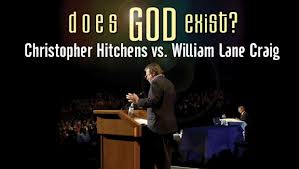
 When it comes to Christopher Hitchens, he was one of my favorites for sure.  He was loved by Christians worldwide, especially after his debate with William Lane Craig because of his humorous nature, his ability to have a respectful exchange and his humbleness in admitting defeat.  I watched him trounce a bunch of pastors and the like but his debates with William Lane Craig and John Lennox were very different.  He was open to the evidence, was passionate but was very clear that he was not certain.  Also it was easily shown that he was very emotional on the topic and was not able to argue against strong Christian apologetics.  He even remarked about how the fine tuning argument for the universe (teleological argument) was the strongest from the Christian side and the most intriguing. Chris Hitchens had many close evangelical Christian friends and even his own brother is a strong Christian apologist.
  My main idea here is the Science vs Religion issue is a false dilemma.  There is no evidence to prove that it is a problem and is not a reasonable position to hold.  It is a popular one though that you will find in media and on internet forums.  If you encounter this issue, just ask for the evidence to be presented that supports it.
Ill stop there and tackle the rest in follow up blogs.


Friday, 17 February 2012

"How do you know when to take the Bible literally?"

  I get asked this question quite a lot.  Usually more aggressively in the way of "everybody knows you cant trust the bible, its not to be taken literally" or things along those lines.  But this is not actually a very hard question to answer.  But I will tell you now that when you do answer this question it will lead to harder ones.

  Lets say you decide to write an account of the events of the summer last year.  You send it into your local newspaper and explain that this is a true story of the events of last summer and you were there for some of the events as well you also interviewed eye witnesses about the events.  But when it gets published it gets published under fiction, or in the poetry section.  This would make no sense at all.  You were very clear this was non fiction, and was not up to personal interpretation. 

  Which brings us to a book like Luke-Acts.  How does he start the account? This is from the ESV
 
"Inasmuch as many have undertaken to compile a narrative of the things that have been accomplished among us, just as those who from the beginning were eyewitnesses and ministers of the word have delivered them to us, it seemed good to me also, having followed all things closely for some time past, to write an orderly account for you, most excellent Theophilus, that you may have certainty concerning the things you have been taught." 

Luke states that he has complied a narrative, interviewed eye witnesses, followed things closely, and has written them down in an orderly fashion.  There is no room here for anyone to suggest that it can be interpreted as symbol or metaphor, or that it is up for interpretation.  Someone could suggest that it is a lie.  That is one of the tough questions that will follow after you address this concern  We will talk about that in a future blog about how you can know the Bible to be true. 

The main point here is context.  In all documents context is key.  "Context context context" if I were to write in this blog that yesterday here in Vancouver it was raining cats and dogs, you would immediately know what I was talking about and probably wouldn't decide that my account was unreliable.  There is symbol, and metaphor in the Bible.  Actually the bible is filled with all the beautiful uses of literature.  But how do you know what is real, and what is interpretive? Context, just like you would understand any other document.

Thursday, 5 January 2012

"atheism makes no claims, it is simply lack of belief"

A friend of mine will use this statement quite often.  If you challenge his worldview he can always retreat to the safety of a worldview that makes no claims.  So, the definition of atheism for many years was that they believed there was no god and to lack belief in god was agnosticism.  Now because of the "new atheism" this definition has changed.  If you were to talk about atheists like Fredrich Nietzsche and Bertrand Russell they would ascribe to the definition that "God does not exist" it is a philosophical stance, and is a stance to be defended.  But today since most of the new atheists are not philosophers they have retreated to this neutral stance.

Many atheists will claim that atheism is just simply a default position.  But is this really true?  If they were neutral then why do you always see them taking sides on issues? A neutral person would stay to the sidelines and pose questions if anything.  You will hear atheists make truth claims all the time.  "there is no such thing as absolute truth"  "we don't need God" "the bible is hopelessly flawed as a document"   "belief in God is silly"  "religion is responsible for the evil in the world"  so when anyone makes a claim they have the responsibility to back it up.  The same goes for Christians, we cannot say God exists without being able to provide some kind of argument, whether that comes from personal experience to evidence from history or science.

Also if atheism really is the default position then new born babies would be atheists.  That would shock the people in my kids church this Sunday morning.  and at the local maternity hospital            

So my main point in this blog is that when you speak with atheists understand that if they are going to engage in conversations about theism/atheism they do have a point of view, and make truth claims.  In the same way that you would make someone back up their political and ethical statements you have to get atheists to do the same thing as well.

Saturday, 31 December 2011

"there is no evidence for the resurrection of Jesus, that is something you take on blind faith"

I was in the gym today, and I started talking with a guy I know from local atheist circles.  When we were talking he said "Robin you seem like such a reasonable guy, but you are always talking about the resurrection of Jesus.  And we know that there is no evidence for it and you just believe it on blind faith"

Now I am just going to address the idea of minimal evidence.  As many people know I came to faith in Jesus based on the evidence of resurrection.  I would love to do a longer blog about the entire cumulative case and I will soon.  But for now I will stick to what I talked about today at the gym.

I said to him that the consensus of critical scholarship agrees with 3 historical facts.

1.  The tomb of Jesus was discovered empty by a group of his women followers on the Sunday following his crucifixion

2. Jesus' disciples had real experiences with someone whom they believed to be the risen Christ Jesus

3. As a result of these experiences the disciples who held the resurrection (that they saw him touched him, spoke with him) at the centre of their belief formed the early church in the very city that these events happened in Jerusalem and then grew from there.


What will shock many atheists about these 3 facts is that these are not questionable facts.  From atheist to christian scholar they agree.  they are not questionable facts.  If you want to check it out for yourself go online or even ask local history professors.  Ive done it, when I was 16 I didn't have google and a computer so I went to UBC and asked.  I asked my high school teachers, I asked my friends high school teachers.  I went to Langara and asked.  So just ask.

The question is, what do we do with these facts?  First we have to decide on the data to be considered, and it is these 3 facts.  Next we have to decide what is the most likely explanation of these facts?  First I can tell you there is no conceivable naturalistic explanation to these facts.  You will hear many explanations but none will hold up.  So why don't people accept that it is possible that Jesus rose from the dead?  Even people like Bart Ehrman (who is a very liberal atheist scholar) agree with the 3 facts.  It is because they are philosophical naturalists.  They have a antisupernatural bias going into the question.  So a resurrection is not a possible explanation. 

So I leave it to you.  What do you do to explain these 3 facts?  It is a huge question and anyone who says it is meaningless is plain wrong.  If a carpenter was walking around saying he was God, was crucified for saying that and then rose from the dead that changes everything.  EVERYTHING.  When I was first interested in Christianity I said to myself, what if this is true?  It would mean that there is a creator and author of the universe and my life, how do I relate with him?  It would mean that I have incredible value, and worth that no one could ever take away from me.  So it was worth looking into. 

Let me also say that as a Christian the primary way that I know the resurrection is true is because I feel the presence of God and the Holy Spirit witnesses to me that it is true.  This is how most people know the resurrection to be true around the world.  But I was led there by the evidence, and anyone who says that there is no evidence for the resurrection of Jesus is plain wrong and literally the weight of the worlds historians is against them.  When they say this they are showing their own bias.

Robin